Trough of Disillusionment
I returned home from Urbit Assembly and settled back into my usual rhythm of part-time work for an artist’s studio and precarious pauses between freelance assignments. I moved to an apartment on the other side of Berlin, seeking a decrease in rent and an increase in social capital. The first night in my new place, my friend Alice came over with take-out, which we ate on the floor. Between bites of bibimbap, we rehashed what I had witnessed at Assembly – a scene that embodied the aspects of a certain strain of Web 3.0 utopianism which Alice has frequently criticized. She is an artist and abolitionist – a teacher and a patient friend who has put up with my often-idealistic interest in blockchains despite her own strongly-held belief that decentralization’s radical roots are better served by what she calls “a relational web,”1 a grassroots mode of peer-to-peer computing that reaches beyond privatized tech and libertarian freedoms. I slept that night on a mattress moved for me by friends I’d paid in beer and Haribo gummies, grateful for the interdependencies that let me feel held, even living in a foreign city. The web at the forefront of my mind that night was not that of cyberlibertarian freedom, of exit from enmeshment – it was a web of relationality, of togetherness amidst the friction of embodied life.
Gradually, I grew less active on Urbit. As I reflected on the tenor of Assembly, my ideological quibbles matured into full-out qualms. In parallel, technical issues mounted, making Urbit even less desirable to use. The network experienced frequent and unexplained downtime, apparently unable to handle its growing user base. Sometimes I logged on to DM the friends I’d made at Assembly – a UX designer on too much Ritalin; an academic doing her PhD under a former member of the CCRU; a drum-and-bass music label boss. Eventually, we all grew aggravated by Landscape’s increasing clunkiness. Our conversations migrated to Signal or otherwise sputtered out.
Urbit’s once-charming friction came to feel like simple disrepair – like they’d blown all the dev salaries on tequila and oranges. As autumn turned to winter, the crypto market tanked, taking with it the once-abundant availability of capital (and attendant inexhaustible enthusiasm) that had driven Urbit’s utopian climate. Tlon laid off a huge proportion of their workforce in early 2023. Increasingly, I worried that the fantasy of a More Beautiful Computer was merely a ZIRP – a “zero interest-rate phenomenon” – a moment of collective excitement engendered by a short-lived uptick in a volatile market.
Under-resourced, Tlon ceased support and development for Port. With Port axed, self-hosting on a laptop was no longer possible. A number of paid third-party hosting services, including one provided by Tlon, sprung up to fill the gap. “Tlon Hosting Services offers the effortless way to claim your home on the network… It's quick. You'll be ready to use Urbit in five minutes – as long as it takes to unpack a new computer,” they advertised.2 Daunted by the prospect of setting up a home server, I reluctantly began paying Tlon a monthly fee to host my planet for me. Privacy was a feature of their marketing rhetoric, but according to employees, the network’s actual encryption was a work-in-progress. “Sovereignty” was more of an aesthetic signal than a description of my actual relationship to my data. In that moment, Urbit came to feel unappealingly similar to the subscription-based cloud services I had previously hoped it might replace.
The sunsetting of Port was a distress signal. Others would follow. The groups that I had been active in on the network – once-vibrant spaces for sharing experimental music and maximally zoomed-in mobile phone photos – grew noticeably quieter. 2023 saw a “mass exodus” of users and developers from the ecosystem, one board member confirmed.3 Finally, in August of 2024, struggles that had been perceptible in the background but never overtly acknowledged came to a head. The Urbit Foundation finally admitted that they had run out of capital and the board of directors fired Lehmann. It was announced that a young and relatively inexperienced developer named Christopher Colby would be named the new CEO. He was rumored to have been hand-picked by ousted founder Curtis Yarvin – who was also announced, at that moment, to be rejoining the project.4 The scope of Yarvin’s power was not specified. In the months since, Colby has been quiet and Yarvin has re-emerged as the public face of Urbit: a founder’s triumphant return to rescue his company from what he has described as “controlled flight into terrain.”5
 Screenshot from video recording of Yarvin's "Urbit as a Society" keynote at Urbit Subassembly 2024.
There are varying accounts of how Urbit reached the breaking point that precipitated this unceremonious leadership transition. In his first public talk after rejoining the project, tellingly branded as his “First Wartime Address,” Yarvin characterized the Urbit Foundation’s missteps prior to his reinstatement as a blend of conservatism and delusion. Unlike many other early-2020s startups built on blockchain infrastructure, Urbit never launched a native cryptocurrency, frequently insisting it was not a “crypto startup.” While the project self-funded by selling address space, it is true that they did not cash in on the trend of capitalizing via an Initial Coin Offering (ICO). This strategy may have lessened their access to capital: “By failing to take the hors do’eurvres while they were being passed around,” Yarvin reflected, “it left us with our integrity intact but it also left us without a ton of money.”6
Nevertheless, as a knock-on effect of the crypto market’s rise, value flowed into the ecosystem, creating a mirage of stability. Parties were thrown; swag was produced; startups and DAOs were launched with the sole focus of building Urbit-native applications. All the while, not enough work was being dedicated to the “general robustness of the system.”7 With Landscape, Tlon had effectively built a beautiful interface that wallpapered over a barely-functional OS. The Urbit Foundation lacked liquidity; developers were getting paid in address space, underwritten mostly by their belief in a project that they, more than anyone else in the community, must have known was failing. With the network’s frequent crashes and bugs, user trust noticeably declined. The Urbit Foundation kept trying to promote user growth, running grants and developer programs to incentivize the building of Urbit-native apps. Limited effort went towards addressing the fact that the core OS was “just not aerospace-grade.”8 Collective faith withered as did financial runway. Yarvin has disclosed that, in the summer of 2024, under Lehmman’s leadership, the Urbit Foundation had been planning to launch a new crypto token to raise money rapidly. Yarvin justifies his return to the project as something of a rescue mission, intervening before such a move could take place. A token, by his assessment, would be desperate and short-sighted, “a shitcoin built on smoke and mirrors” undermining Urbit's longstanding refusal to cash in on crypto.9
Yarvin’s diagnosis of the Urbit Foundation’s missteps is partial, focusing on a handful of choices made in his absence. In part, he blames the ambivalent approach to speculation taken by the Foundation – but their effort to grow a user base even when the fundamentals weren’t yet “aerospace-grade”10 was far from the only problem; many startups scale by selling ideas which are not-yet fully forged. It is relatively common practice among crypto startups in particular to rapidly capitalize by playing the game of financial speculation: as Matt Hwang, co-founder of the venture firm Paradigm Capital, has written, “the casino” of the market can be harnessed to fund the creation of more long-term durable projects.11 In a critical take on the matter, the art critic Marina Vishmidt writes of “speculation as a mode of production” – acknowledging that the speculative logic fundamental to financial capitalism can transform uncertainty itself into a source of surplus value.12 Was the Foundation’s marketing strategy a naive attempt to force-meme their product into existence, or a realistic assessment of the fact that capitalism increasingly functions through the manipulation of potential futures rather than the direct extraction of labor value alone? In a word, it was hyperstitional. Social buzz, it turns out, is relatively simple to fictionalize into existence; complex technologies, considerably less so.
To my mind, a more robust analysis would also acknowledge that Urbit’s governance has been dysfunctional from the outset. In the absence of explicit guardrails to create accountable governance, struggles are liable to flare up in many open-source projects. Urbit was unfortunately no exception. Urbit’s kernel is licensed as open-source; the code is publicly visible and people beyond Tlon and the UF’s payroll contribute to its development. Yet decision-making around the project’s direction is not particularly participatory or transparent. Urbit sits uneasily between realms: is it an open-source software project abiding by the reigning norms of peer production? A startup developed by a private corporation? Or one enthusiast’s passion project, subject to his particular will?
In certain aspects, Urbit has attempted to structure some transparency into its governance, in line with the reigning norms of open-source. A process for submitting “Urbit Improvement Proposals” (UIPs) exists on GitHub, following the common practice of allowing “requests for comment” to enable community discourse around proposed changes to open-source codebases.13 The stated aim of the UIP process is to “make core development decision-making visible and open to entry.” However, the UIP process is underutilized – at best, a vestigial nod to cultural convention. The UIPs currently in consideration on GitHub address only marginal technical features, like hair-splitting standards considerations for the Urbit machine code specification.
Wider discussions of the project’s structure and procedures for decision-making are noticeably absent from this public arena. A category of “Process UIPs” meant to address meta-guidelines for development is outlined on the GitHub page. As of this writing, only one process-related proposal (beyond the inaugural one outlining the UIP submission process) has ever been created. Submitted in March of 2023, it outlines a change addressing data portability across hosting providers. Two years on, it remains in the draft stage. Decisions like sunsetting Port were not subject to the UIP process: rather, they were made by Tlon, acting unilaterally as a de facto authority.
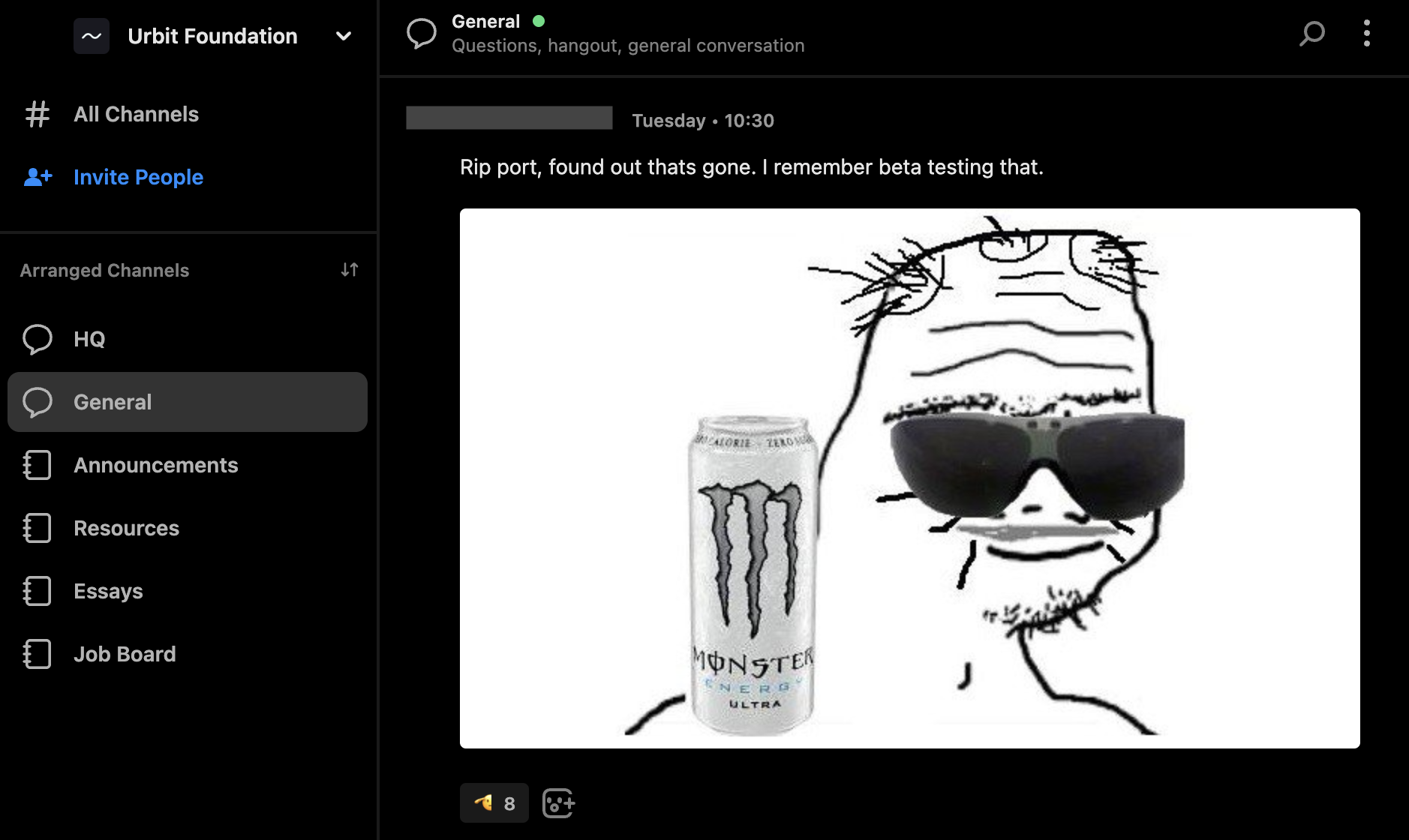 Screenshot from Urbit Foundation "General" channel, accessed via Tlon Landscape interface, February 2025.
In practice, Tlon holds outsized power over Urbit governance. Tlon was instrumental in facilitating Urbit’s access to venture capital. It could afford full-time salaried developers who logged more hours than the open-source project contributors who chipped in as unpaid labors of love. Tlon’s power is also reflected in the distribution of Urbit IDs: The critic and technologist Francis Tseng calculated that, as of 2019, 185 of Urbit’s 256 galleries were owned by Tlon, Tlon employees, and Urbit Foundation employees; that group also accounted for almost 38,000 of the network’s 65,500 stars.14 Despite the project’s lip service to decentralization, address space ownership is highly concentrated.
Urbit’s early designs and official documentation dictate that decision-making power is proportional to ownership of address space on the network. Yarvin has called Urbit a “transparent plutocracy”15; while “transparency” is a stretch, Tlon evidently serves as one plutocratic power. The docs outline the presence of a “Galactic Senate” comprised of galaxy owners,16 but it is unclear how or whether the Galactic Senate actually participates in decision-making around development priorities, process changes, and leadership appointments. The Urbit Foundation’s board is distinct from the Galactic Senate, which are separate from Tlon leadership in turn. There are likely overlaps among these entities due to the distribution of address space, although the exact contours of each group’s power and influence are difficult to trace. Then, when Urbit hit an impasse in 2024, it became clear that – regardless of the stated procedures for governance – only one person was really in charge. That person is Curtis Yarvin.
Urbit’s governance structure is an outgrowth of Yarvin’s political ideology. Tellingly, he has been known to call himself “the Prince”.17 In a speech given to Urbit developers following his reinstatement, Yarvin bluntly offered his perspective that “democracy is the most beautiful…but not the most effective” form of governance.18 Elsewhere, in a 2024 Gray Mirror post, he mused that “by historical standards, [democracy] … is not necessarily excellent, let alone superlative or even exceptional, [and] perhaps – not even good.”19 These are, at least nominally, the beliefs that got him “off the project” in the first place, the toxic associations from which Tlon wisely sought distance. But the residue of Yarvin’s politics was never fully excised. I felt their influence at Assembly in the tacit nods to libertarian exit fantasies peddled by figures like Srinivasan. It is my contention that these residues are not just politically pernicious, but that they constitute a failure mode for digital networking: it was this tendency towards a feudal concentration of power which undermined Urbit, reflected in the disorganized governance which precipitated its decline.
~
In the past, Yarvin has expressed his anti-democratic views in much less measured terms. In certain corners of the internet, Yarvin is better known by the alias Mencius Moldbug. Under that name, he penned a blog called Unqualified Reservations from 2007 until 2014. There, he developed a bizarre political philosophy, fusing monarchism with free-market libertarianism – a chimera he calls “neo-cameralism.” Yarvin-as-Moldbug was fond of arguing that democracy is ineffective; “[democratic] government does not rule,” he writes, “it decays.”20 It should be replaced, by his estimation, with something more resembling corporate governance – or power by divine provenance, vested in the technological elite. “The ideal government,” writes Moldbug, “is a corporation that owns its country in the same way that Apple owns its factories or Microsoft owns its software.”21 Attempting to reconcile libertarian interests with his open enthusiasm for unilateral rule, Moldbug lands on the position that a nation should be run like a tech startup, and a tech startup should be run like a monarchy. If one takes issue with the rules to which they are subject, whether imposed by their Urbit host-star or a territorial CEO-king, their only recourse is to vote with their feet. In his preferred style of governance, the body politic – peons, planets, people – have no voice, only the “freedom” to exit.
Moldbug’s position was shared by Nick Land – former CCRU member turned cult right-wing blogger – who coined the term “Dark Enlightenment” to describe this political program. Sometimes labeled “neo-reaction” (NRx for short), it fuses the authoritarian leanings of Scottish philosopher Thomas Carlyle with influences from far-right writers like Hans-Hermann Hoppe to argue for the failure of liberal democracy and proposes a patchwork of competing jurisdictions in a “free market for governance” in its place.22 Land published an encyclopedic text, titled “The Dark Enlightenment,” outlining the principles of this “movement” and drawing heavily on Moldbug: “Once the universe of democratic corruption is converted into a (freely transferable) shareholding in gov-corp, the owners of the state can initiate rational corporate governance, beginning with the appointment of a CEO.”23 Drawing on the work of the economist Albert O. Hirschman, Land schematizes governance in the Dark Enlightenment polis as a matter of “no voice, free exit.”
While once confined to the online fringe, neo-reactionary views have filtered into the US political mainstream. A lite version of Land’s claim that “democracy is not merely doomed, it is doom itself” rings out in venture capitalist Peter Thiel’s notorious sound bite that democracy and freedom are “not compatible.”24 (No wonder, then, that Thiel was one of Urbit’s earliest investors.) Moldbug is sometimes credited with originating the acronym RAGE – ”Retire All Government Employees”25 – which was taken up by Steve Bannon in his vow to dismantle the administrative state,26 and has surfaced again with the onset of Donald Trump’s second presidential term. Vice President J.D. Vance has cited Moldbug as an influence;27 in a 2021 interview, Vance stated that “what Trump should do is fire every single middle-level bureaucrat, every civil servant in the administrative state and replace them with ‘our people,’”28 which is exactly what he appears to have set out to do.
Yarvin maintains that his proximity to Vance is often overstated. Still, the affinity between their positions is conspicuous. A 2022 Vanity Fair article by James Pogue describes Thiel and Vance as “friends” of Yarvin’s, and Vance is a former employee of Thiel’s firm Mithril Capital.29 The rising tide of anti-democratic sentiment online and off in the wake of the 2024 US presidential election seems unmistakably downstream of Moldbug the thinker, if not explicitly Yarvin the IRL person. In response, a self-described “broad, bipartisan, and decentralized network of experts” published a brief in February of 2025 calling the rise of neo-reactionary politics – a position that they attribute to Land and Moldbug – “an “immediate, existential threat to the very existence of the American nation-state.”30
Critiques of Urbit that take stock of Yarvin’s troubling politics have been circulating since well before I joined the network. That I largely tuned them out is a testament to my cognitive dissonance, my tunnel vision, desperate for utopia. Writing in 2019, Francis Tseng questioned whether Urbit’s attempt to market itself as a platform that grants users “more autonomy and control” could hold up in light of Yarvin’s established affinity for monarchy.31 Tseng mapped Yarvin’s ideology directly to Urbit’s network design, which, while notionally decentralized, makes power proportional to property in a manner that Yarvin himself has termed “digital feudalism.” Lachlan Kermode similarly argues that Yarvin’s political beliefs are inextricable from Urbit’s network structure. Kermode proposes that software functions as a form of infrastructure – and infrastructure, in shaping the provision of resources, is inherently political.32 Kermode points out that Urbit’s design embodies Yarvin/Moldbug’s neo-reactionary views in its governance model, “all exit, no voice,” such that the network can never be “neutral.” Considered this way, it becomes difficult to view Urbit as anything other than Yarvin’s ideology made manifest.
Moldbug’s identity as Curtis Yarvin was revealed in 2013. Since then, he has been the locus of criticism interrogating the affinities between the technology industry and the rise of alt-right politics.33 Pushback within the free software community following Moldbug’s unmasking led Yarvin to be uninvited from conferences like Strange Loop and LambdaConf.34 When Yarvin abruptly walked away from Urbit in 2019, he claimed that he took his leave on his own volition, motivated by a desire to see Urbit grow under new leadership: “From the very start, I knew Urbit could not succeed until it ceased to be mine and became the world's,” he wrote in a post to the Urbit blog.35 However, some community members speculate that Yarvin was forced out – possibly under pressure from Tlon leadership – as Urbit approached market-readiness.36
In Yarvin’s absence, Tlon and the Urbit Foundation undertook a strenuous whitewashing effort, scrubbing his name from public-facing communication about the project. They maintained the rhetorical focus on sovereignty over one’s tools that had animated Yarvin’s original vision, but stripped it of any neo-reactionary valence, excising the talk of “digital feudalism” that Yarvin had so gleefully embraced.37 Tlon marketed heavily to artists and designers, and the Urbit Foundation targeted their outreach to FOSS enthusiasts and the DAO-curious.38 The focus became the more palatable notion of a “sovereign stack” (which was literally the name of an Urbit fan podcast39), minimizing reliance on Big Tech platforms and granting users more agency over their computing environment.
Thanks in part to this rebrand, Urbit managed to retain a plausibly ambivalent position vis-a-vis its founder’s unsavory views. As Kermode grants, it poses a conundrum: certain players in the free software space remain drawn to its vision of reimagining internet infrastructure and its nod to peer-to-peer networking.40 Its promise to re-decentralize the internet – at least insofar as it offers users an alternative to ceding their data to MEGACORP services – speaks to an urgent need for platforms that afford users more ownership and control. This was what drew me and kept me around. But Urbit’s promise of “sovereignty” revealed itself as disingenuous as the governance crisis came to a head – undermined by feudal character of Yarvin’s design.
NEXT →
-
Alice Yuan Zhang, “Unpacking the Myth of Web 3: Decentralization of What?,” Becoming Infrastructure, 2022, https://aliceyuanzhang.com/decentralization.html. ↩︎
-
“Join Tlon Messenger,” Tlon Hosting Services, accessed March 6, 2025, https://tlon.network/landing. ↩︎
-
Marc Hochstein, “‘Wartime CEO’: Urbit’s Founder Returns in Shakeup at Moonshot Software Project,” CoinDesk, August 21, 2024, https://www.coindesk.com/tech/2024/08/21/wartime-ceo-urbits-founder-returns-in-shakeup-at-moonshot-software-project. ↩︎
-
Noah Kumin, “What Just Happened with Urbit?,” The Mars Review of Books, August 17, 2024. ↩︎
-
“Curtis Yarvin’s First Wartime Address (Live),” August 23, 2024, https://www.youtube.com/watch?v=ltLiGb5CoQs&ab_channel=Urbit. ↩︎
-
Ibid. ↩︎
-
Ibid. ↩︎
-
Ibid. ↩︎
-
“Third Wartime Address: On Urbit Governance with Curtis Yarvin (Live),” November 1, 2024, https://www.youtube.com/watch?v=ev9aF5RVaOo. ↩︎
-
Ibid. ↩︎
-
Matt Huang, “The Casino on Mars,” Paradigm, September 20, 2023, https://www.paradigm.xyz/2023/09/casino-on-mars. ↩︎
-
Marina Vishmidt, Speculation as a Mode of Production: Forms of Value Subjectivity in Art and Capital, Historical Materialism Book Series, Volume 176 (Leiden ; Boston, MA: Brill, 2019). ↩︎
-
Nadia Eghbal, Working in Public: The Making and Maintenance of Open Source Software, First Edition (San Francisco: Stripe Press, 2020), 40. ↩︎
-
Francis Tseng, “Who Owns the Stars? The Trouble with Urbit,” Distributed Web of Care, May 4, 2019, https://distributedweb.care/posts/who-owns-the-stars/. ↩︎
-
“Third Wartime Address: On Urbit Governance with Curtis Yarvin (Live),” November 1, 2024, https://www.youtube.com/watch?v=ev9aF5RVaOo. ↩︎
-
“Docs - Urbit,” accessed October 4, 2024, https://docs.urbit.org/. ↩︎
-
Colin Lecher, “Alt-Right Darling Mencius Moldbug Wanted to Destroy Democracy. Now He Wants to Sell You Web Services,” The Verge, February 21, 2017, https://www.theverge.com/2017/2/21/14671978/alt-right-mencius-moldbug-urbit-curtis-yarvin-tlon. ↩︎
-
“Third Wartime Address: On Urbit Governance with Curtis Yarvin (Live),” November 1, 2024, https://www.youtube.com/watch?v=ev9aF5RVaOo. ↩︎
-
Curtis Yarvin, “More Reflections on the Kamala Koup,” Substack newsletter, Gray Mirror, (July 22, 2024), https://graymirror.substack.com/p/more-reflections-on-the-kamala-koup. ↩︎
-
Mencius Moldbug, “An Open Letter to Open-Minded Progressives,” Unqualified Reservations, April 17, 2008, https://www.unqualified-reservations.org/2008/04/open-letter-to-open-minded-progressives/. ↩︎
-
Mencius Moldbug, “Chapter 1: The Red Pill | A Gentle Introduction to Unqualified Reservations” Unqualified Reservations, January 8, 2009, https://www.unqualified-reservations.org/2009/01/gentle-introduction-to-unqualified/. ↩︎
-
Joshua Tait, “Mencius Moldbug and Neoreaction,” in Key Thinkers of the Radical Right, by Joshua Tait (Oxford University Press, 2019), 187–203, doi:10.1093/oso/9780190877583.003.0012.; Hans-Hermann Hoppe, Democracy - the God That Failed: The Economics and Politics of Monarchy, Democracy and Natural Order (Abingdon, Oxon New York, NY: Routledge, Taylor & Francis Group, 2001). ↩︎
-
Nick Land, The Dark Enlightenment (US: Imperium Press, 2022). ↩︎
-
Nick Land, “Neoreaction (for Dummies),” Outside In, April 17, 2013, https://web.archive.org/web/20200129155012/http://www.xenosystems.net/neoreaction-for-dummies/.; Peter Thiel, “The Education of a Libertarian,” Cato Unbound, April 13, 2009, https://www.cato-unbound.org/2009/04/13/peter-thiel/education-libertarian. ↩︎
-
Harrison Smith and Roger Burrows, “Software, Sovereignty and the Post-Neoliberal Politics of Exit,” Theory, Culture & Society 38, no. 6 (2021): 143–66, doi:10.1177/0263276421999439. ↩︎
-
George Michael, “An Antidemocratic Philosophy Called ‘Neoreaction’ Is Creeping into GOP Politics,” Ohio Capital Journal, July 28, 2022, https://ohiocapitaljournal.com/2022/07/28/an-antidemocratic-philosophy-called-neoreaction-is-creeping-into-gop-politics/. ↩︎
-
David Marchese, “Curtis Yarvin Says Democracy Is Done. Powerful Conservatives Are Listening.,” The New York Times, January 18, 2025, sec. Magazine, https://www.nytimes.com/2025/01/18/magazine/curtis-yarvin-interview.html. ↩︎
-
James Pogue, “Inside the New Right, Where Peter Thiel Is Placing His Biggest Bets,” Vanity Fair, April 20, 2022, https://www.vanityfair.com/news/2022/04/inside-the-new-right-where-peter-thiel-is-placing-his-biggest-bets. ↩︎
-
Ibid. ↩︎
-
Anonymous, “The Imminent Neoreactionary Threat to the American Republic,” February 5, 2025. ↩︎
-
Francis Tseng, “Who Owns the Stars? The Trouble with Urbit,” Distributed Web of Care, May 4, 2019, https://distributedweb.care/posts/who-owns-the-stars/. ↩︎
-
Lachlan Kermode, “Deconstructing Urbit: The Politics of Software as Infrastructure,” February 21, 2022, https://lachlankermode.com/live/2022.09.21-deconstructing-urbit.pdf. ↩︎
-
See Corey Pein, “Mouthbreathing Machiavellis Dream of a Silicon Reich,” The Baffler, May 19, 2014, https://thebaffler.com/latest/mouthbreathing-machiavellis.; James Pogue, “Inside the New Right, Where Peter Thiel Is Placing His Biggest Bets,” Vanity Fair, April 20, 2022, https://www.vanityfair.com/news/2022/04/inside-the-new-right-where-peter-thiel-is-placing-his-biggest-bets. ↩︎
-
David Auerbach, “The Curious Case of Mencius Moldbug,” Slate, June 10, 2015, https://slate.com/technology/2015/06/curtis-yarvin-booted-from-strange-loop-its-a-big-big-problem.html.’; “Final Statement on the LambdaConf Controversy | Hacker News,” April 11, 2016, https://news.ycombinator.com/item?id=11475740. ↩︎
-
Curtis Yarvin, “A Founder’s Farewell,” January 13, 2019, https://urbit.org/blog/a-founders-farewell.; “Urbit Foundation | History,” n.d., https://urbit.org/overview/history. ↩︎
-
Noah Kumin, “What Just Happened with Urbit?,” The Mars Review of Books, August 17, 2024. ↩︎
-
The feudal character of Urbit’s network hierarchy was explicit in Yarvin's early design sketches, where users were classified not as "galaxies," "stars," and "planets," but rather as “dukes,” “lords,” and “earls.” ↩︎
-
For examples of Urbit’s efforts to market to these demographics, see posts from the Urbit Blog including N E Davis, “Urbit’s Open Source Culture, Part I,” Urbit Blog, May 31, 2023, https://urbit.org/blog/foss-1.; Anthony Arroyo, “The Shape of DAO Governance to Come,” Urbit Blog, August 17, 2022, https://urbit.org/blog/the-shape-of-dao-governance-to-come. ↩︎
-
“Sovereign Stack,” X, https://x.com/Sovereign_Stack. ↩︎
-
Lachlan Kermode, “Deconstructing Urbit: The Politics of Software as Infrastructure,” February 21, 2022, https://lachlankermode.com/live/2022.09.21-deconstructing-urbit.pdf, 11. ↩︎