Slope of Enlightenment
Contrary to utopian conceptions like Barlow’s, the history of the web is rife with evidence that decentralized networks do not automatically equate to more horizontal power relations among users.1 Decentralized data storage, while enabling users to retain more power over one aspect of their online existence, does not guarantee more equitable distribution of power. This equation of decentralization and disintermediation with self-sovereignty has been central to Urbit’s brand identity – but as history and present experience both teach, it isn’t so straightforward. Nevertheless, the language of “sovereignty” is fundamental to Urbit's value proposition. In a 2024 speech, Yarvin put it tellingly: “One of the benefits of a personal server… is that a personal server really allows you to step into your own aristocracy in a much deeper kind of way.”2
As Yarvin’s reference to “aristocracy” emphasizes, Urbit’s conception of sovereignty is a narrow one. Perhaps this should have been obvious to me from the outset, signaled by its allusions to a “new world,” a “clean slate.” At bottom, these represent fantasies of exit – akin to Srinivasan’s Network State unburdened by democratic processes, taxes, and the messy entanglement of bearing with others. Echoes of cyberlibertarian utopianism reverberate here as the digital is imagined as an escape hatch from territorial constraints, with little attention paid to the power structures that inhere in its infrastructure and social layer alike.
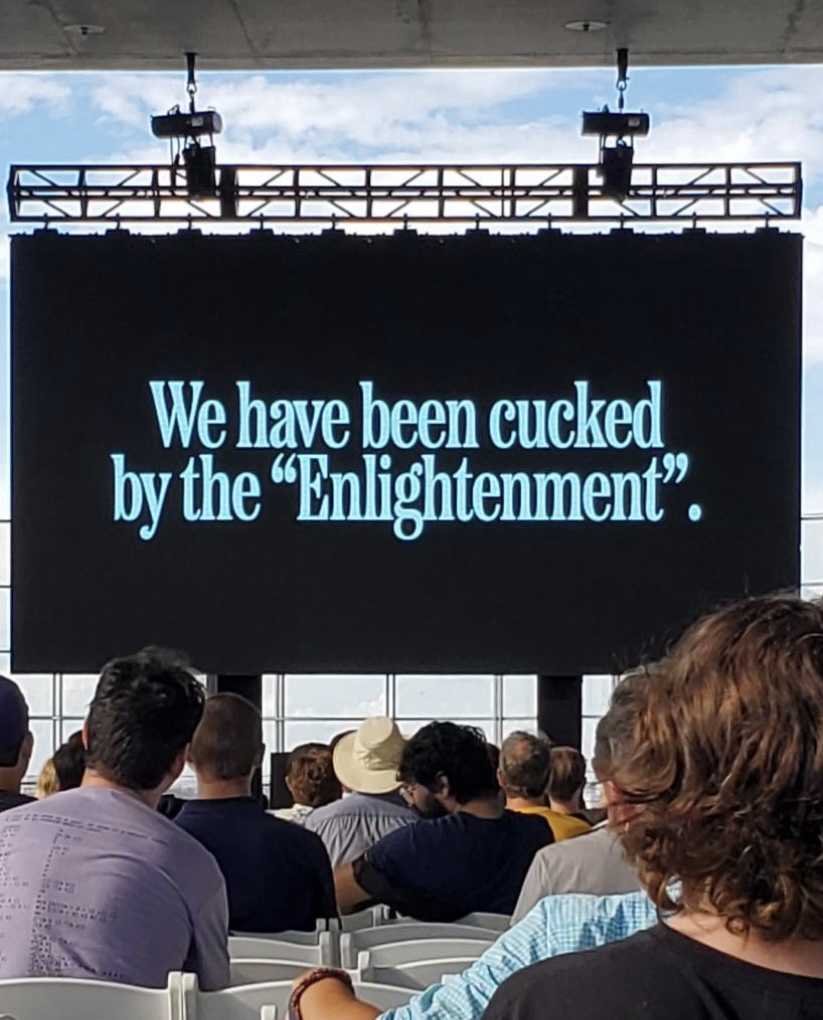 A slide from a talk by Riva Tez at Urbit Assembly, 2022.
This vision of sovereignty reaches back in Western thought at least as far as Friedrich Nietzsche, but it has held a special place in libertarian tech-enthusiast circles thanks to William Rees-Mogg and James Dale Davidson’s book The Sovereign Individual. The book was hugely popular among users of the Cypherpunks mailing list following its 1997 publication; the newest edition, re-issued in 2020, includes an adulatory preface by Peter Thiel. The Sovereign Individual predicted that technological innovations in the early 21st century – especially digital networks and cryptography – would erode the power of nation-states, empowering wealthy individuals to secede and form new networks of their own design.3 Digital money, it claimed, would undermine government-backed currencies, enabling individuals to store wealth beyond government reach. It forecasted the rise of a libertarian fantasy that in many ways resembles Urbit: a patchwork marketplace for governance, where ownership and technological savvy are proportional to political power.
Individual sovereignty characterized thus is surely not novel. The historian Fred Turner has explored how countercultural ideals of personal liberation, self-sufficiency, and “exit” from dominant society became the bedrock of Silicon Valley’s culture of “innovation.”4 With the rise of economic neoliberalism in the 1980s, this doctrine of individual self-reliance and social change through small-scale technologies or “tools” dovetailed with deregulated markets to create what Richard Barbook and Andy Cameron call “the Californian Ideology.”5 This ideology, in the vein of Barlow’s cyberlibertarianism, imagines the internet as a space free from hierarchy where entrepreneurial free-thinkers can chart their own paths to success, unencumbered by the relations that bind them in territorial life.6 Barbrook and Cameron situate the myth of the “digital frontier” as a key pillar of this ideology, comparing the belief in the openness of cyberspace to narratives of the American frontier.
As my views on digital sovereignty have evolved, I have grown to see this ideology as suspect. The notion of free, unstructured, uncharted territory – “New World Energy” in either the physical or virtual realm – is a dangerous fallacy. The mythology of the American frontier advanced extraction and colonial conquest; it was invoked to justify the enormous scale of violence and murder of native people that underpinned the establishment of the so-called “New World” as we know it today. Kermode associates the image of an open ocean, which previously graced Urbit’s homepage, with tropes of freedom that originate in European colonial seafaring;7 one might also connect these tropes to endeavors like Peter Thiel and Patri Friedman’s Seasteading Institute, a botched neo-colonial experiment in generating “free markets for governance” on floating platforms at sea.
The myth of the digital as uncharted territory also obscures how the hardware and infrastructure on which it runs reinscribe colonialism and racial bias. Kate Crawford has documented the neo-colonial mining and manufacturing practices involved in the production of digital technology.8 Likewise, theorists like Jonathan Beller,9 Jackie Wang,10 and Ruha Benjamin11 have explored how computation operates today as a planetary-scale apparatus that extracts labor and material resources, transforming human cognition and attention into capital and designating entire populations as essentially expendable according to algorithms that encode anti-black and carceral logics. Across these forms of oppression and exploitation, extracted value accrues to what McKenzie Wark calls the “vectoralist class” – the stratum of platform and infrastructure owners including Thiel, Musk, and Yarvin.12
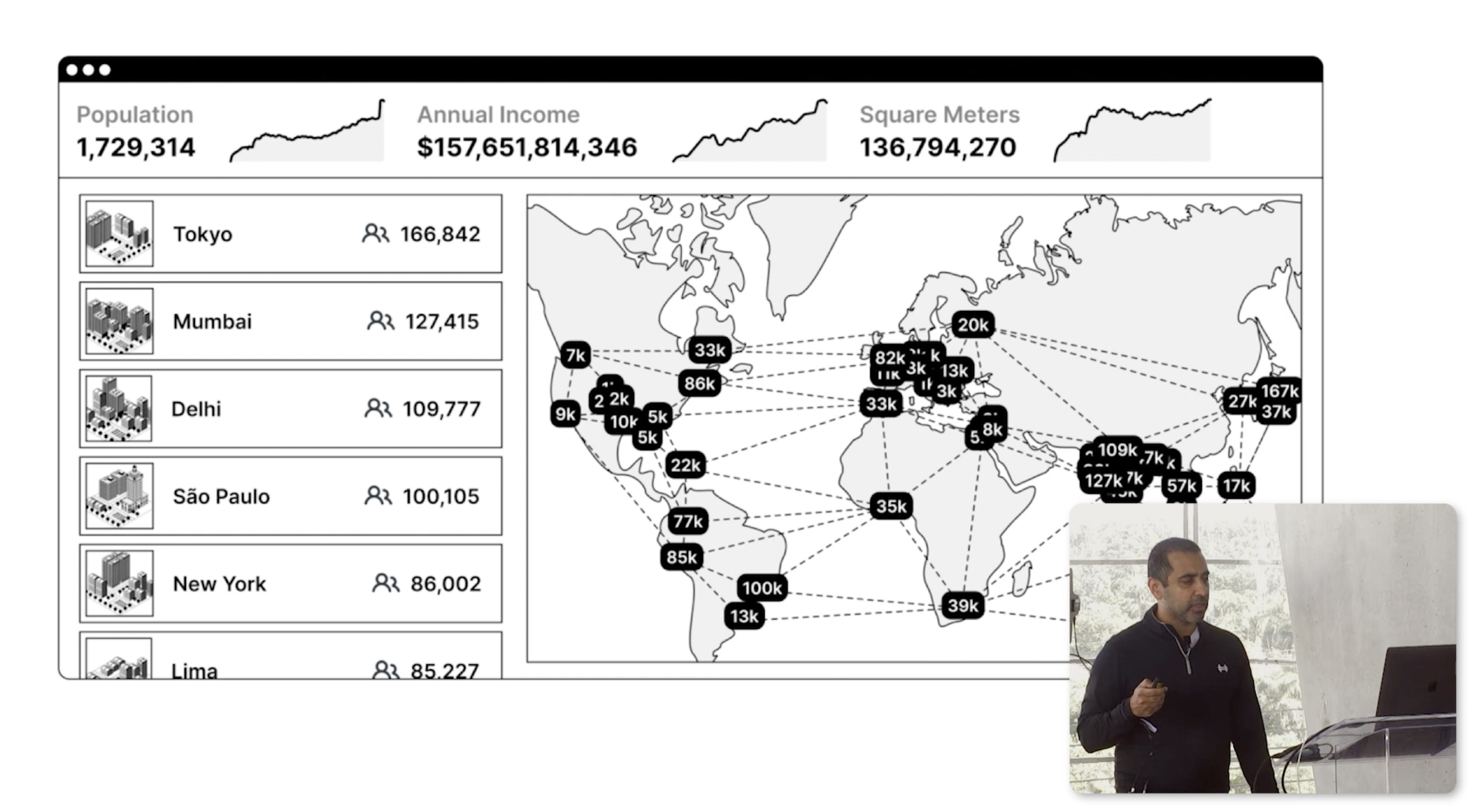 Balaji Srinivasan gives a talk on The Network State at Urbit Assembly, 2022.
Individual sovereignty as Urbit conceives of it – ultimately geared towards a world which is “free as in markets”13 and markets only – quickly reveals the limits of its freedom. The mythology of The Sovereign Individual does not constitute a meaningful break from the hierarchies that structure either the dominant technology platforms or extant American politics today; if anything, it only intensifies them. The future that Davidson and Rees-Mogg predicted has in some ways been realized, but not because it was inevitable. It was simply aligned with the interests of capital. Urbit represents, in this sense, an intensification of the feudal character of platform capitalism – not an exit from it. As this realization has set in, I have started to wonder: what other conceptions of user sovereignty, more expansive and redeeming, could be built up in its place?
Yarvin’s preferred interlocutor for making sense of sovereignty is Thomas Carlyle. Mine has come to be Hannah Arendt. Arendt’s distinction between sovereignty and freedom is instructive in grasping what went wrong with Urbit: “If men wish to be free,” Arendt writes, “it is precisely sovereignty they must renounce.”14 She explains, inverting the libertarian ideal of total personal freedom, that “under human conditions, which are determined by the fact that not man but men live on the earth, freedom and sovereignty are so little identical that they cannot even exist simultaneously.”15 The fantasy of individual sovereignty is essentially anti-political, treating the ties and bonds of life in the social world as mere bondage. The result is the delusion that pure self-reliance is a desirable, or even feasible, endpoint for liberation – the “freedom” of Sovereign Individualism, which is in practice the freedom of the jungle.
The feminist energy theorist Cara Daggett likewise contrasts the limited notion of “liberty as independence” against other traditions of freedom, including many arising in nonwestern contexts, that value not independence but dependency. There is security, she argues, in being enmeshed in a network of distributed relations of support. Drawing on disability studies and Marxist-feminist analyses of care work, Daggett summarizes the fantasy of self-sovereign independence as “a fantastical notion of life, because life is completely dependent.”16 The rise of authoritarian notions of self-sovereignty today, Daggett contends, comes as a direct response to the anxiety produced by the revelation of this dependency – a psychic projection of inflated independence catalyzed by feelings of impotence brought on by the myriad threats to life in an uncontrollable world.
This anxious disavowal of dependency is what I now see in Urbit, manifesting in its dysfunctional governance, justified by its idealization of a rugged power-user exiting MEGACORP for the freedom of the digital frontier. Yet for all its grounding in an individualist notion of sovereignty, the project is remarkably agnostic to the idiosyncrasies of actual life being lived – the varied experiences of the people behind the “stars” and “planets,” the materiality of the hardware they host them on, the practices of daily life that sustain these users and enable them to pay their electricity bills to keep their “self-sovereign” servers online. Over-indexed on this limited ideal of sovereignty, Urbit has created conditions that reinscribe the extant hierarchies of the offline world. In so doing, it has undermined the very notion of user emancipation it once seemed to offer.
NEXT →
-
See Alexander R. Galloway, Protocol: How Control Exists after Decentralization (Cambridge, Mass.: MIT Press, 2006); Nathan Schneider, Governable Spaces: Democratic Design for Online Life, (Oakland, CA: University of California Press, 2024). ↩︎
-
Urbit as a Society, Recorded Talk, Urbit Subassembly 2024, https://www.youtube.com/watch?v=FeBb33DSVbo. ↩︎
-
James Dale Davidson and William Rees-Mogg, The Sovereign Individual: Mastering the Transition to the Information Age (New York: Touchstone, 1999), 240-242. The Sovereign Individual also likely informs Yarvin’s “neo-cameralism”: Davidson and Rees-Mogg write that, in the post-nation-state world enabled by the internet, politics will be replaced by client-business relationships, foreshadowing Land and Yarvin's “gov-corp” and “CEO-kings.” ↩︎
-
Fred Turner, From Counterculture to Cyberculture: Stewart Brand, the Whole Earth Network, and the Rise of Digital Utopianism (Chicago, Ill: University of Chicago Press, 2008). ↩︎
-
Richard Barbrook and Andy Cameron, “The Californian Ideology,” Science as Culture 6, no. 1 (1996): 44–72, doi:10.1080/09505439609526455. ↩︎
-
This worldview conveniently ignores the ways in which the internet itself was directly a product of public investment via projects like DARPA, and dispenses with the realities of physical infrastructure that support this utopian realm. See E. Glen Weyl, “Sovereign Nonsense: A Review of The Sovereign Individual by James Dale Davidson and Lord William Rees-Mogg,” Blog, RadicalxChange, (January 18, 2022), https://www.radicalxchange.org/media/blog/sovereign-nonsense/; M. Mitchell Waldrop, The Dream Machine: J.C.R. Licklider and the Revolution That Made Computing Personal (San Francisco: Stripe Press, 2018). ↩︎
-
Lachlan Kermode, “Deconstructing Urbit: The Politics of Software as Infrastructure,” February 21, 2022, https://lachlankermode.com/live/2022.09.21-deconstructing-urbit.pdf, 12. ↩︎
-
Kate Crawford, Atlas of AI: Power, Politics, and the Planetary Costs of Artificial Intelligence (New Haven London: Yale University Press, 2021). ↩︎
-
Jonathan Beller, The World Computer: Derivative Conditions of Racial Capitalism, Thought in the Act (Durham: Duke University Press, 2021). ↩︎
-
Jackie Wang, Carceral Capitalism, Semiotext(e) / Intervention Ser, v. 21 (Cambridge: Semiotexte/Smart Art, 2018). ↩︎
-
Ruha Benjamin, Race after Technology: Abolitionist Tools for the New Jim Code (Cambridge, UK ; Medford, MA: Polity, 2020). ↩︎
-
McKenzie Wark, “The Vectoralist Class,” e-flux Journal 65 (May 2015), https://www.e-flux.com/journal/65/336347/the-vectoralist-class/. ↩︎
-
This phrasing is often attributed to the open-source software programmer Richard Stallman stating that free software is “free as in liberty, not free as in beer.” ↩︎
-
Hannah Arendt, “What Is Freedom?,” in Between Past and Future: Eight Exercises in Political Thought, Penguin Classics (New York: Penguin Books, 2006), 165. ↩︎
-
Ibid, 164. ↩︎
-
Cara Daggett, Son[i]a #343: Cara New Daggett, Podcast, Son[i]a | Ràdio Web MACBA, 2022, https://rwm.macba.cat/en/podcasts/sonia-343-cara-new-daggett-2/. ↩︎