Plateau of Productivity
In view of these considerations, I have gradually stopped using Urbit. I have ceased to feel the craving, the once-compelling libidinal pull. “User sovereignty” remains an important rejoinder to Web 2.0, yet it no longer strikes me as the singular value orienting alternative digital futures. This piece of writing is one aspect of my personal, ongoing process of reallocating effort and attention towards other values, other networks. As I exit Urbit, I aim to re-plant my digital presence in tools that do not promise individual self-reliance so much as facilitate collective care. What would it mean to build networks geared towards solidarity rather than sovereignty? Not homesteads, but homeplaces, to borrow Nathan Schneider’s invocation of bell hooks?1 Rather than exit, how can networks recognize our enmeshment – with each other and with the natural world? Through my gradual disillusionment with Urbit, I have come to believe that digital networking cannot retreat or withdraw from present inequalities; these hierarchies persist and must be reckoned with, for cyberspace is not separate from history or the physical world.
The video artist Martine Syms, in The Mundane Afrofuturist Manifesto, underscores how the pseudo-utopian dream of “exit” relies on our forgetting: losing track of the physical, material experience of our infrastructure; obscuring the historical and contemporary relationships of extraction and ecological destruction that underpin the digital; and scrubbing the anti-blackness that inheres in our digital infrastructure, stemming from the truth that “cyberspace was prefigured upon a “master/slave” relationship.”2 Instead of buying into these occlusions, Syms urges the pursuit of “world building outside of imperialist, capitalist, white patriarchy.”3 That pursuit resonates with the second meaning of “speculation as a mode of production” detailed by Marina Vishmidt. Beyond the materialization of value through finance capital, speculation can refer to imaginative interventions that create new conceptual frameworks capable of resisting existing regimes of control.4 Speculative worldbuilding of this kind affirms that extant hierarchies of power are not immutable – inverting Nick Land’s view of hyperstition, reflected in the views of contemporary technology investors like Marc Andreessen, where all progress is driven by the unfolding of techno-capital, agnostic to the human.
Another kind of speculation is possible, a mode of futuring rooted in small-scale interventions in the here-and-now. Spideralex, a member of a Catalan cyberfeminist collective called Donestech, argues that the realm of the speculative is where “we find a way to release ourselves from the myth of science and technological progress.”5 Perhaps there is a hyperstitional quality to this mode of speculation, too – harnessing the quasi-magical qualities of both code and language to produce new realities – but it does not take capital’s acceleration as its telos. Rather, it harmonizes with what Donna Haraway calls “speculative fabulation”: practices of myth-making and storytelling that account for the messy truths of entangled existence in order to challenge dominant narratives.6
Ayana Zaire Cotton, the founder of the Seeda School – an online school that teaches Black Feminist theory alongside software engineering – explicates the connection between this mode of speculation and the production of new technological infrastructure: “The world we’re tumbling into no longer needs star engineers who write flawless code,”7 she writes, in step with the critique of “meritocracy” in software development set forth by Coraline Ada Ehmke.8 What we need, according to Cotton, are “stewards who understand the poetic and complex work of relationship, resource distribution, and creating irresistible portals to otherwise.” Ehmke likewise calls for deeper engagement with the ethical implications of software projects and stronger codes of conduct within peer production communities. Not a “clean slate” or an exodus into a Network State, but grassroots infrastructures of care in the here-and-now.
These calls to action resonate with a list that has been passed around in cyberfeminist circles over the years, variously named the Feminist Server Manifesto or a Wishlist for Transfeminist Servers – a morphing set of desires for what feminist techno-ecologies are and could be.9 According to these texts, a feminist server “is autonomous in the sense that she decides for her own dependencies” and “does not strive for seamlessness;” rather, “seamfulness and response-able relationality” are welcome in the process of self-hosting beyond the mainstream tech stack. In this, I read a celebration of friction – not unlike how I once felt using Urbit. But unlike Urbit’s idealization of the power-user as individual sovereign, feminist infrastructure acknowledges the reality of dependency and the work that sustains mutualistic relations.
Another touch-point in my approach to self-hosting was the notion of a “feminist server stack” set forth by Nancy Mauro-Flude & Yoko Akama, who explore how a server – or network of servers – can become an affective infrastructure, a site for the dynamic negotiation of needs that spawn new alliances, new relationalities, new worlds.10 Their explication harmonizes with the concept of a relational web that Alice introduced me to over take-out that evening in Berlin, emphasizing the physicality of digital technologies that we are too frequently given to viewing as immaterial. Infrastructure, as Kermode reminds, is always-already situated amidst the messy and unequal realities of the here-and-now.11 A “new internet” built on narrow ideals of individual sovereignty, occluding the history of networked computing’s entwinement with the body – and particularly the embodied realities of racial capitalism and colonial exploitation – is not so new, after all.
If decentralization can still be seen to hold radical potential, its glimmers come from the grassroots. In her critique of Web 3, Alice uplifts the work of the “communities of collaborative neighbors, refugees, abortion-seekers, digital hacktivists, witchy femmes, and others targeted or neglected by dominant systems who must and indeed have learned to uphold technological sovereignty together.”12 She rejects the argument made by cryptographer Moxie Marlinspike that “people don’t want to run their own servers, and never will,” emphasizing that so many communities who live outside the imagination or concern of the vectoralist class already must, can, and do.
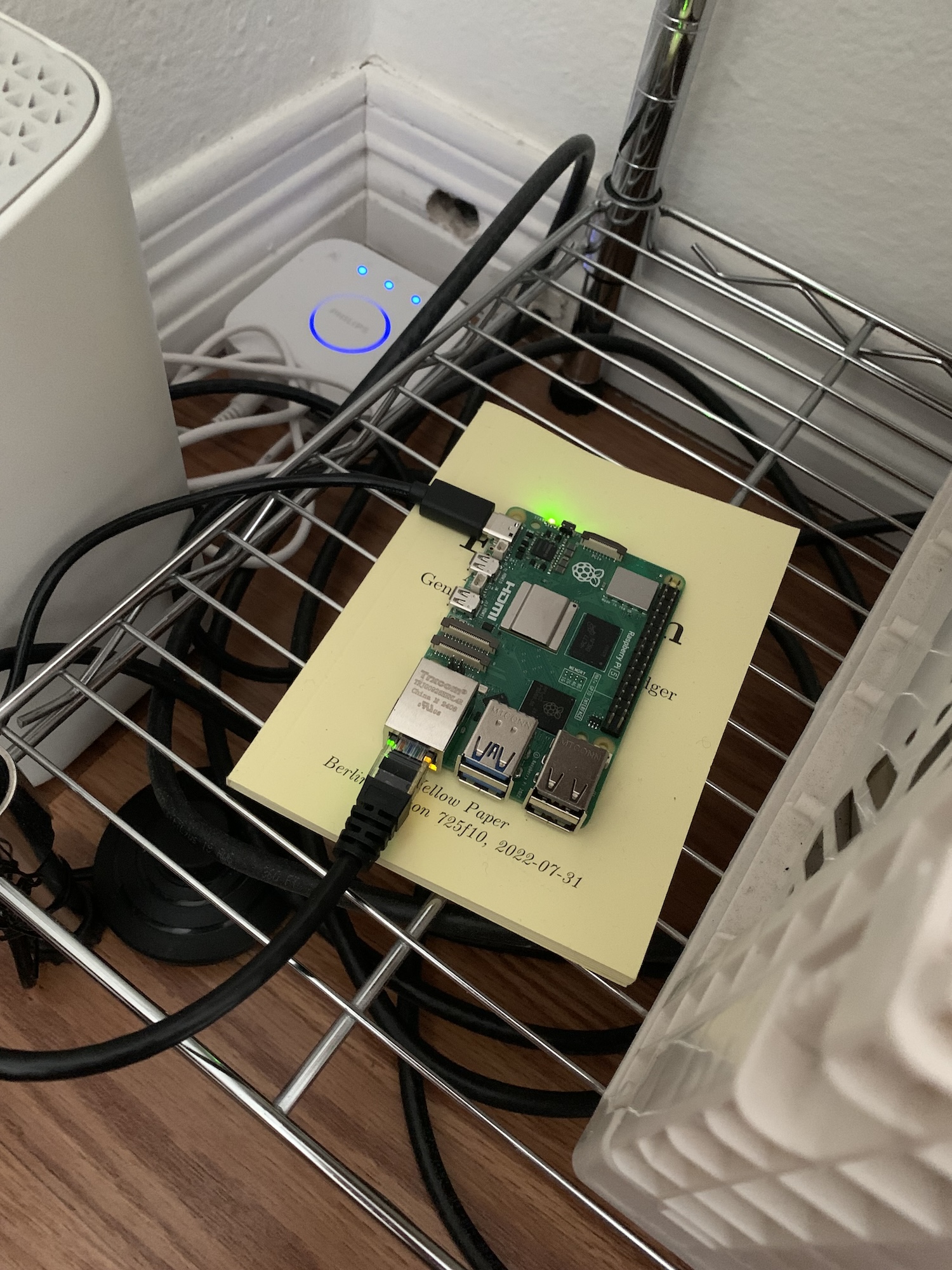 The birth of a home server.
So, in a baby step towards realizing a more care-full infrastructure, I am taking responsibility for the technological practice that first incited my break from Urbit: I finally learned how to self-host a home server. This foray into self-hosting was not a solo journey. I learned these techniques as a student in a 10-week online class called Solidarity Infrastructures at the School for Poetic Computation.13 One of the course themes aptly summarizes my wider project here: moving from “do-it-yourself” to “do-it-together.”
There is now a Raspberry Pi on a bookshelf in my bedroom in Boulder, serving the website on which this piece of writing is published. I set up the Pi using a kit from a local independent electronics store, toggling between internet forums to troubleshoot and texting friends for tech support. Getting the server up and running was a slow and, at times, frustrating process – friction-full in exactly the way I claimed to embrace, but in reality shied away from, in my time as an Urbit user.
I kept needing one more thing, one more unforeseen piece of hardware. I scrounged a keyboard from my dad’s basement. I nervously navigated the command line while installing Yunohost, recalling the time in college when I accidentally uninstalled my own operating system while playing around in the terminal. I eventually got the server up and running, naming it “Binky,” after my mother’s childhood nickname. My internet service provider gave me trouble at every turn, barraging me with menacing texts about a “security threat” and unhelpfully hiding the tool for setting up port-forwarding in the depths of an iPhone app. While I was out of town, my housemate unplugged Binky, convinced it was burdening our home WiFi network and slowing down his Zoom calls.
I felt something like parental protectiveness; tears welled in my eyes when I rebooted Binky upon my return. I groaned and cursed and muttered when things did not function as intended, unleashing torrents of “oy gevault,” a Yiddish expression of exasperation I picked up from my mother, who picked it up from hers – generations of women speaking the language of diaspora to lament the minor frustrations of labors of love. If you’re reading this, that means that the server is up and running. That means that my housemate’s robot vacuum has not found its way into my room and knocked the power source out of place; the Pi has not collected dust or overheated; the utility bill got paid on time.
[Update - 1 June, 2025: I have moved out of my old apartment in Boulder, and anticipate moving a few more times in the coming months to accommodate some life changes. Leaving my old apartment sadly entailed unplugging Binky, rendering the original version of this project inaccessible. So I made a backup running on a virtual private server. I opted to create an iteration that would be accessible and maintainable regardless of my geographic whereabouts. I hope to set up Binky, the OG Pi, again – likely at my parents' house – in addition to maintaining this copy for contingency.]
Overcoming my resistance to self-hosting was not merely a matter of technical upskilling. It was a process I only felt equipped to undertake because folks in various communities I am a part of showed me that a different relationship to my networking practices was possible. I remain critical of the ways that Tlon devalued accessible self-hosting, and in some ways still locate that as my formative moment of disillusionment with Urbit. But even now that I feel a little more confident in my ability to keep a server up and running, I will not be deploying this newfound skill to return to Urbit and host my own planet. I am not interested in “stepping into my own aristocracy,” actualizing Yarvin’s fantasy of power-user elitism. The process of learning to set up a server, contrary to Urbit’s foundational mythology, did not make me feel like a sovereign. Rather, it foregrounded the extent to which I rely on others, my excellent fortune to exist within these relations of care.
So, this is not an ending. It is an entry-point into actualizing different values than the ones that structure the status quo. It is a call for the liberatory conception of “speculation as a mode of production”: experimentation committed to not just philosophizing, but practicing, otherwise. It is an intervention at an almost laughably small scale: friction-full as I might have found the process, it is no great feat to set up a Raspberry Pi. The work I did to launder Urbit’s reputation, participating as I did in their rebranding effort, also lives on. Even as I exit the network, I am mired in dissonance and contradiction as much as ever. My offering in this tiny intervention is simply to enact an alternative view on what matters. It is an act of writing that also instantiates the ideas it describes into existence, not as hyperstition but a deliberate weaving of the speculative into the real – acknowledging, in step with the movement for Trans*feminist Servers, that “both technology and humanness as entangled praxes in the making.” No prophecy is self-fulfilling, no monarchy eternal. No future is definitively written. No platform or tool, technology or mythology, is intrinsically given to sovereignty, whatever that means in the first place. If it has emancipatory potential, it is the users – the storytellers – that make it so. ☆
-
Nathan Schneider, Governable Spaces: Democratic Design for Online Life (Oakland: University of California Press, 2024), 40-55. ↩︎
-
Martine Syms, “The Mundane Afrofuturist Manifesto,” The Third Rail, May 1, 2017, http://thirdrailquarterly.org/martine-syms-the-mundane-afrofuturist-manifesto/. ↩︎
-
For more detailed accounts of the internet's historical relationship with anti-blackness than I am able to offer in the space of this essay, see Neta Bomani, “Dark Matter Objects: Technologies of Capture and Things That Can’t Be Held,” 2018, https://netabomani.com/darkmatter/.; American Artist, “Black Gooey Universe,” Unbag Magazine, Winter 2018, https://unbag.net/issue-2-end/black-gooey-universe/. ↩︎
-
Marina Vishmidt, Speculation as a Mode of Production: Forms of Value Subjectivity in Art and Capital, Historical Materialism Book Series, Volume 176 (Leiden ; Boston, MA: Brill, 2019). ↩︎
-
spideralex, “Underneath and on the Sidelines: Sustaining Feminist Infrastructures Using Speculative Fiction” 2019, https://donestech.net/files/iterations-spideralex-underneath-and-on-the-sidelines.pdf, 9. ↩︎
-
Donna Haraway, “SF: Science Fiction, Speculative Fabulation, String Figures, So Far,” Ada: A Journal of Gender, New Media & Technology, November 1, 2013, doi:10.7264/N3KH0K81. ↩︎
-
Ayana Zaire Cotton, “Our Only Job Is Tending To Our Imagination,” Substack newsletter, Seeda School, (January 30, 2023), https://seedaschool.substack.com/p/our-only-job-is-tending-to-our-imagination. ↩︎
-
Coraline Ada Ehmke, “The Dehumanizing Myth of the Meritocracy,” Model View Culture, May 19, 2015, https://modelviewculture.com/pieces/the-dehumanizing-myth-of-the-meritocracy. ↩︎
-
“A Feminist Server Manifesto 0.01,” May 29, 2014, https://areyoubeingserved.constantvzw.org/Summit_afterlife.xhtml; “Wishlist for Trans*Feminist Servers,” 2018, https://etherpad.mur.at/p/tfs. ↩︎
-
Nancy Mauro-Flude and Yoko Akama, “A Feminist Server Stack: Co-Designing Feminist Web Servers to Reimagine Internet Futures,” CoDesign 18, no. 1 (January 2, 2022): 48–62, doi:10.1080/15710882.2021.2021243. ↩︎
-
Lachlan Kermode, “Deconstructing Urbit: The Politics of Software as Infrastructure,” February 21, 2022, https://lachlankermode.com/live/2022.09.21-deconstructing-urbit.pdf. ↩︎
-
Alice Yuan Zhang, “Unpacking the Myth of Web 3: Decentralization of What?,” Becoming Infrastructure, 2022, https://aliceyuanzhang.com/decentralization.html. ↩︎
-
“Solidarity Infrastructures,” accessed March 26, 2025, https://infrastructures.us/. ↩︎