Acknowledgements
This text and website comprise the capstone project for my MA in Media and Public Engagement, submitted to the Media Studies Department at the University of Colorado, Boulder in April 2025. As I hope to have strongly communicated throughout this text, I am of the belief that no creative work is ever undertaken alone.
Thanks to my wonderful committee – Nathan Schneider, Lori Emerson, and Michela Ardizzoni – for your careful feedback, support and guidance. It is a privilege and an honor to learn from scholars so generous with their extensive knowledge and so versed in the value of community-engaged scholarship. Likewise, thanks to my fellow MAPE students for workshopping and intellectual cross-pollination throughout my time in this program.
I owe an immense debt of gratitude to the community that formed around the online “Solidarity Infrastructures” course at the School for Poetic Computation, taught by Meghna Mahadevan, Max Fowler, and Olivia McKayla Ross. My thinking has also been deeply informed by conversations with participants in the Open Social Incubator at the Media Economies Design Lab, which I have had the honor of stewarding over the 2024-25 academic year. I have also been grateful for so many conversations with MEDLab colleagues throughout my time in Boulder. Presence in these spaces has supported my process of technical upskilling and has been formative to my theoretical understanding of what is at stake in establishing alternative networks.
Thanks to all of the participants in the workshop at Trust, and to Lina Martin-Chan for help in organizing it. The insight generated in that workshop was central to the formulation of my research questions, and each participant’s presence was a welcome reminder that thinking is richer and more joyful when we do it together.
All of these containers were foundational in shaping my approach to the fundamental question at issue in this project: How can we share responsibility and power for our collective, interwoven digital existences, situating them on infrastructure that is underpinned by politics of solidarity and mutual care?
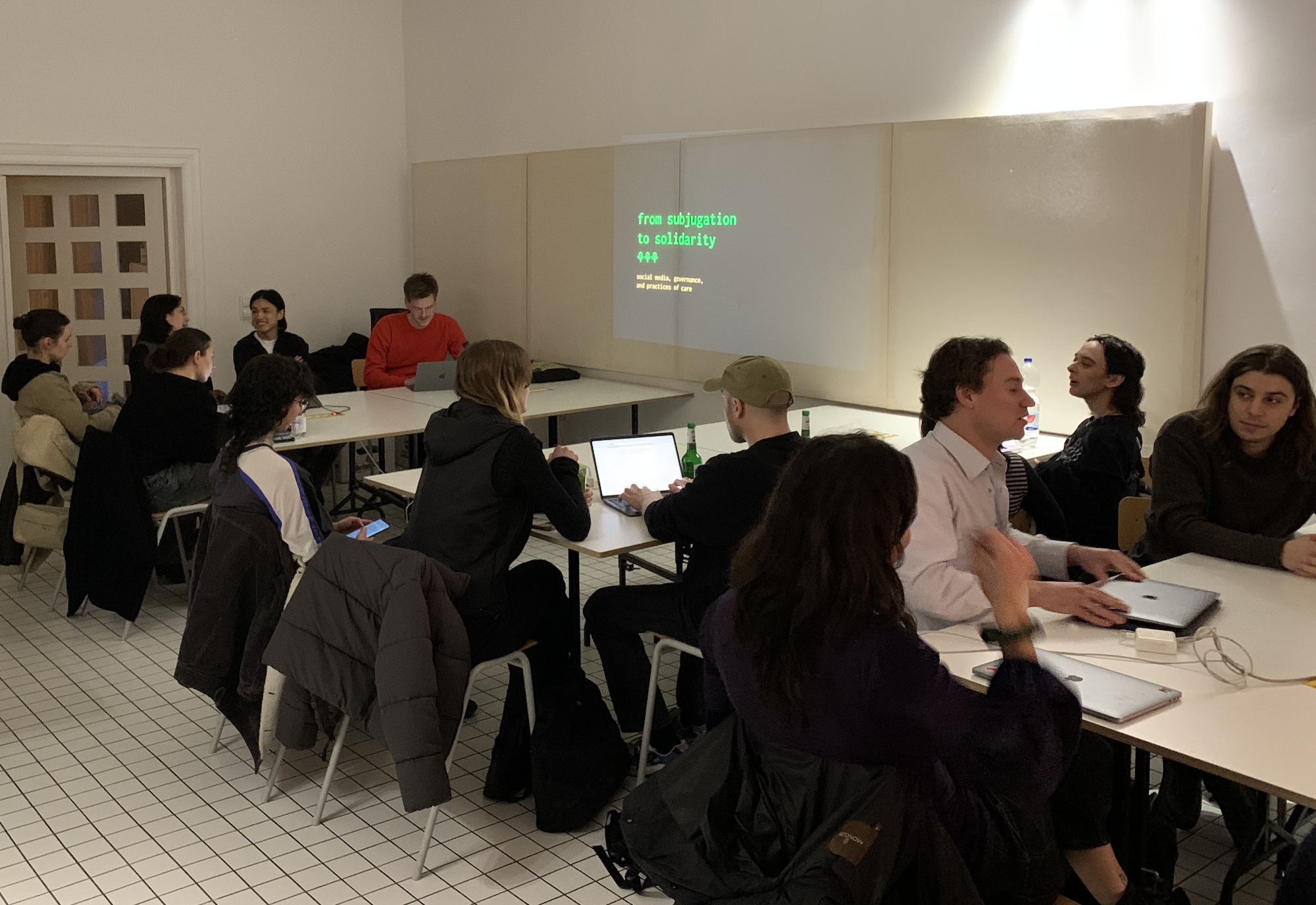 Workshop on alternative social media networks at Trust in Berlin, January 2025.
On that note: heartfelt thanks to my “intellectual kin” (a turn of phrase borrowed from Taeyoon Choi) around the world, whose thought around these questions in formal and informal contexts has shaped mine. Inexhaustively: Alice Yuan Zhang, Chris Dake-Outhet, Graham Johnson, Sam Diamond, Ian Berman, James Brennan, Martina Cavalot, Max Fowler, Melanie Hoff, Sarah Friend, Simon Denny, Toby Shorin, and others...
Thanks to the fellow Urbit users, community members, and observers who have processed the question of what makes “a more beautiful computer” alongside me over the years: Becca, Ellie, Gordon, James, José, Josh, Kaya, Lars, Norm, and Yatu. You all are evidence that “the real Urbit is the friends we made along the way.”
Thanks to Dad, Auntie Karen, Fuffy & Ricki, Isabel, Rory, Jaco & Bretta, and others for feeding me and reminding me to breathe while I worked on this thesis, continually drawing my attention back to the realities of embodiment and the webs of care that sustain.
Deepest gratitude to my mom, Robin Glickstein, z''l – a.k.a. “Binky” – for always supporting my creative and intellectual endeavors with the utmost enthusiasm. You taught me what it means to give and receive care, and I miss you every day.