Technology Trigger
Summer 2020: the early Coronavirus lockdowns forced all manner of social life online, kettling us into group texts, Discord chats, and Zoom windows. Amazon, Microsoft, Apple and Google saw surging stock prices in the early days of the pandemic as the internet came to serve as a basic necessity, albeit a privatized one: an inescapable but imperfect infrastructure for collective life. In stretches of warm weather between successive lockdowns, social life took on a disorienting polarity: being together was possible outdoors or on the computer, disjointed realities in the realm of atoms and the realm of bits.
I shut my laptop one evening, eyes tired from a remote workday consisting of back-to-back video calls, and met up with some friends in a Brooklyn park. My vision was strained, neck tense from the brutal ergonomics of my laptop. Sitting on the damp ground after sunset, I made small-talk with someone I hadn’t met before, feeling rusty and self-conscious – it had been a while since I'd socialized in that manner. “What do you do?” was all I could muster. He wore head-to-toe black and thin wire-rimmed glasses. His name was either John or Jimmy. He worked for a startup called Tlon. He described his job there as building “a more beautiful computer.” That was a claim that captured my interest.
Urbit promotional graphic designed by Romina Malta.
The name of the mysterious startup that employed him, I later learned, came from a short story by Jorge Luis Borges. “Tlon, Uqbar, Orbis Tertius” tells of a secret society that conjures a new world by describing it – penning an encyclopedia that brings itself into being, overwriting the reality that existed before. Tlon Corporation employed a handful of my friends-of-friends – mostly people I’d met through my nascent interest in blockchain technology, which seemed to offer one alternative to the frustrating status quo of “Web 2.0.” Murmurs circulated: Tlon was doing something edgy, provocative for reasons I could not pin down.
Tlon was developing something called Urbit – a project that no one could seem to explain except in idealistic platitudes: the More Beautiful Computer. By its official tagline,1 Urbit is “a clean-slate OS [operating system] and network for the 21st century”; elsewhere, it is described as “an attempt to build a new internet on top of the old internet”2 or a “quest to make the internet p2p again.”3 Put as simply as I can muster: Urbit is a network of personal peer-to-peer cloud computers. It styles itself as a rejoinder to the current internet, rebuilding networked computing from first principles.
Urbit's development has been in progress for something on the order of two decades, first under the sole purview of its founder, Curtis Yarvin, and later under the joint supervision of Tlon and a nonprofit called the Urbit Foundation. Its product has two main components: Arvo, its operating system, and Azimuth, an Ethereum smart contract that divides up address space on its network. Urbit’s address space – in essence, its virtual real estate – is divided into a federated hierarchy of “planets,” “stars,” and “galaxies,” each unique according to a 28-bit identifier. The ultimate aim is to create a decentralized network where each user owns all their data: a private virtual machine, protecting them from surveillance and attention economy ad-tech, keyed into a web of savvy likeminds.
That sounded more beautiful to me, though admittedly, I wasn’t sure what all of it meant. I liked that Urbit aligned itself with peer-to-peer networking and open-source software – two realms I had just begun to explore in my search for alternatives to the platform capitalist present. Urbit promised to safeguard against the spying, exploitation, and lock-in we had come to expect from the mainstream regime – what is sometimes referred to as the FAANG stack, and which Urbit documentation glosses as MEGACORP. Decentralized network structure, Urbit’s adherents believed, would lead to more equitable social life online. What was missing in my relationship to the MEGACORP platforms, I realized, was sovereignty: I was a serf, a voiceless and expendable user at the base of a virtual fiefdom. The desire for sovereignty over my networking stack refracted a deeper desire: something to do with getting freer.
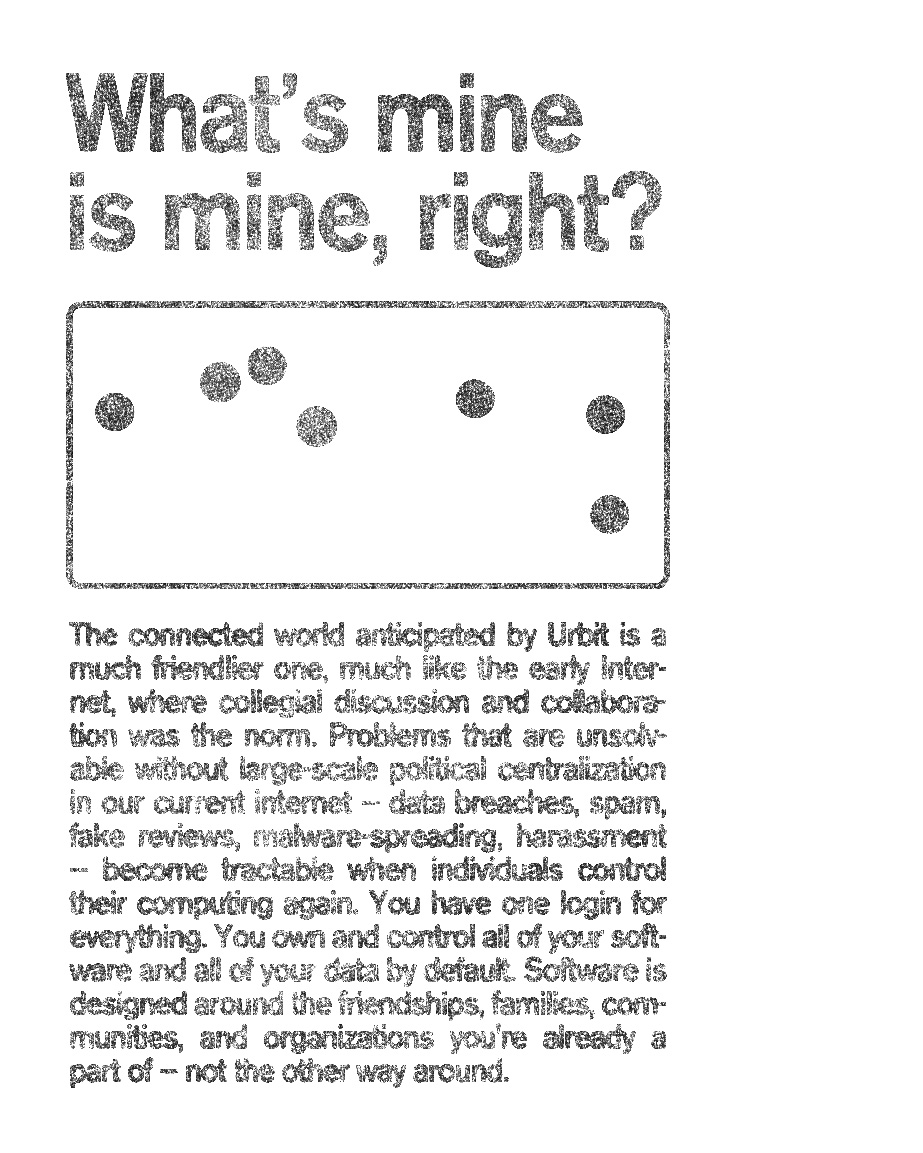 Urbit promotional graphic designed by Romina Malta.
“What’s mine is mine, right?” reads the headline of an advertising graphic designed by Tlon employee Romina Malta, whose aesthetic direction has shaped Urbit’s brand identity. “The connected world anticipated by Urbit is a much friendlier one,” the graphic goes on, “much like the earlier internet, where collegial discussion and collaboration was the norm.” A selective vision of the internet's history, to be sure. An origin myth worthy of believing in. “Problems that are unsolvable without large-scale political centralization in our current internet…become tractable when individuals control their computing again.” Human-scale computing for distributed coordination: this was the narrative that drew me to Urbit.
This appeal to self-ownership and conviviality, coordination without centralization, was hardly exclusive to Urbit. The rhetoric in Malta’s graphic, characteristic of Urbit’s branding at the time, shares a certain narrative through-line with other efforts to “re-decentralize” the internet as a response to Web 2.0, including a number of Ethereum projects that sought to build “Web 3.0,” or a new, decentralized internet using blockchains.4 Despite its infrastructural reliance on Ethereum, Urbit does not identify itself as a crypto startup. Nevertheless, it shares in the fantasy that has been endlessly propagated, from the early web to the crypto boom, of securing greater individual sovereignty and new distributions of power as a consequence of decentralization.
This ambition calls to mind the cyberlibertarianism of John Perry Barlow, whose 1996 “A Declaration of the Independence of Cyberspace” viewed the nascent World Wide Web as a realm of liberation from the constraints of offline life.5 What Barlow termed “cyberspace,” he viewed as a province of newfound freedom where individuals could exchange information freely, conduct their economic lives as they pleased, and create their own rules outside of extant hierarchies. Decentralization of social power was taken to be an inevitable effect of the internet’s decentralized architecture. This assumption was animated by a curious fusion between idealistic notions of a digital commons and libertarian freedom from territorial governments.
Yet as the internet became more established, this vision collided with economic realities: as users increased and infrastructure costs rose, network effects took hold. With the rise of so-called Web 2.0 through the aughts and 2010s, power grew concentrated in the hands of the small number of largely unregulated corporations operating the centralized platforms – MEGACORP, if you want – which hold outsized power today. The origin myth of decentralization had not hedged against this outcome, but maybe, projects like Urbit reasoned, a new wave of resistance to centralization could halt it.
NEXT →
-
“Docs - Urbit,” accessed October 4, 2024, https://docs.urbit.org/. ↩︎
-
Colin Lecher, “Alt-Right Darling Mencius Moldbug Wanted to Destroy Democracy. Now He Wants to Sell You Web Services,” The Verge, February 21, 2017, https://www.theverge.com/2017/2/21/14671978/alt-right-mencius-moldbug-urbit-curtis-yarvin-tlon. ↩︎
-
Marc Hochstein and Daniel Kuhn, “Urbit Courts DAOs, Crypto Teams in Quest to Make Internet P2P Again,” CoinDesk, May 11, 2023, https://www.coindesk.com/layer2/2022/09/24/urbit-courts-daos-crypto-teams-in-push-to-make-internet-p2p-again. ↩︎
-
Gavin Wood, “ĐApps: What Web 3.0 Looks Like,” Insights Into a Modern World, April 17, 2014, https://web.archive.org/web/20150816021358/http://gavwood.com/dappsweb3.html. ↩︎
-
John Perry Barlow, “A Declaration of the Independence of Cyberspace,” Electronic Frontier Foundation, January 20, 2016, https://www.eff.org/cyberspace-independence. ↩︎